
Sunderland AFC 1888/89
___________________________________________________
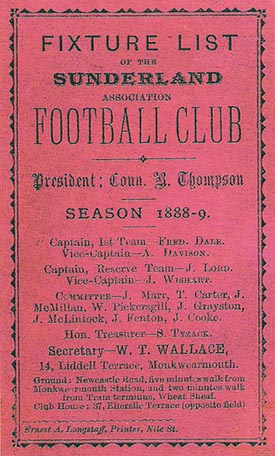
For the 1888/89 season Sunderland Albion fielded 4 teams. As there quite simply wasn’t the support for 2 teams in the town the battle for survival was on. The loser would go out of existence. 25 August saw a practice match at Newcastle Road for the benefit of J Oliver who had recently broken his arm. Over 3,000 people watched the game between the Sunderland AFC - whites (first team) and the reds (reserves), the former running out 6 v 1 victors. The same day the half yearly meeting was held in the Workman’s Hall monkwearmouth. The President Mr Robert Thompson occupied the chair and "there was a large attendance of members". Part of the meeting concentrated on the Newcastle Road ground arrangements which had realised the pledge to build a new grandstand and club house. J Oliver, for whom the above benefit/practice match had been played, was presented with a cheque for over £26. Secretary Mr Wallace gave a financial statement in which he announced that field renovations at Newcastle Road would be carried out at a cost of £500. The season started in earnest 1 September 1888 with a visit from the powerful Blackburn Rovers outfit and a cracker of a match it proved to be. Sunderland won the fixture 4 v 3, a very significant result, bearing in mind the outcomes of previous meetings with clubs of a similar stature. Sunderlands playing strength had been increased due in part to the acquisition of Dickson, the Scottish international, and in monsoon conditions the 5,000 hardy souls who attended were well rewarded, with entertaining, end to end football.
One week later Sunderland "A's" met Darlington reserves and whilst the 5 v 0 scoreline is nothing to write home about a reproduction of the team line up will begin to give an indication of the Sunderland squad for the season: Potts, Wishart, Jobling, Plumpton, Christie, Stonehouse, Douglas, Angus, Curran, Lord, W Peacock. Note that 2 Peacock brothers were on the books at the time. On the same day as the above the Sunderland first team travelled to South Bank and thrashed the home side 7 v 0. Brady, Rennie, Breconridge started the rout and the 600 spectators present watched on in amazement as their favourites were demolished. After 3 weeks on tour the Canadians arrived on Wearside having played competitively in both Ireland and Scotland. Their record so far read 5 wins, 3 defeats and 2 draws. It was a great honour that Sunderland were chosen as the first English opponents, yet more evidence of the growing stature of the club and the go ahead nature of the "Directors". The Canadians arrived on the Friday night and were put up at the Grand in Bridge Street, for the match that would take place on 22 September. It was a glorious day and the crowd numbered around 10,000. Sunderland emerged first and had some shooting practice with the ex Cambuslang full back Gourlay now in our ranks, interest was immense. The Canadians took the field in a dark blue "costume" with the white lettering "the dominion" emblazoned on their shirts. Sunderland attacked with the sun at their backs. It was soon evident that the visitors were a cut above anything Sunderland had so far faced this season and even though we were defeated 0 v 3 it was a great experience for Wearside. 29 September saw Sunderlands 2 teams win...the "A's" at Seaton Carew 12 v 1 and the first select gained a well deserved 2 v 1 triumph against Grimsby at Clee Park. The latter being regarded as "without doubt the most severe test so far this season". Sunderland were now starting to look quite formidable. 6 October and the first round of the English Cup saw Sunderland receive a bye. In order to keep the players active they entertained Sheffield Wednesday. The Wearsiders roared into a 5 minute lead, through Dickson. For all Wednesdays’ subsequent pressure they were finding it hard to penetrate Sunderlands resolute defence and it was no surprise when the Wearsiders broke away and scored a second. The Yorkshire team pulled one back just before the finish. Another victory...against another good team. On week later and the first team suffered, what was now, a rare defeat, 0 v 2, at the hands of old rivals Darlington at Feethams. The "A" team defeated St Paul’s 6 v 1. Middlesbrough "A" team were the next to suffer a heavy defeat by Sunderlands second string 6 v 1 whilst the first team played out a 2 v 2 draw against the Teesside teams first eleven. The draw for the next round of the English Cup, to be played on 27 October, saw Sunderland paired with Elswick Rangers, a home tie at Newcastle Road which was eagerly awaited. With 5,000 spectators present the 3rd round tie got underway with a strong wind blowing. The weather would play an important part in deciding the outcome. In what was a quite fantastic game Sunderland were victors by 5 v 3, their success due to goals from Brady (2), Breconridge (2) and Peacock.
The season was now in full swing and the 11th match of the season brought a return fixture with Grimsby. A very hard game ensued and the 1 v 1 scoreline was considered a fair result. 14 November brought about a 6 v 0 home triumph over Durham University and 3 days later the "A's" met Port Clarence at Haverton hill, Teesside. 2 v 2 the final outcome. However, the most significant match that day was the next round of the English Cup which saw Sunderland entertain Newcastle East end at Newcastle Road, in a match interrupted by showery weather. The main talking point was the strength of Sunderlands defence, and the 2 v 0 victory, was hard earned, with East end trying in vain to penetrate our half back line. What then followed was something quite remarkable...Sunderland withdrew from the competition. The reason to be honest was simple...we had been drawn to play Sunderland Albion in the next round. With James Allen’s new team having defeated Shankhouse Black Watch, Newcastle West end and Birtley interest in the fixture would have been immense with large revenues raised. However such was the animosity between the 2 clubs that Sunderland refused to line the pockets of their now great/bitter rivals, and so promptly conceded. The same then happened in the Durham Challenge Cup and all hell broke loose. But Sunderland wouldn’t budge. 24 November saw the Lads make their first trip to Lincoln and a hard fought 1 v 1 draw was just reward for their endeavour, the same day, the second string defeated bishop Auckland 4 v 2. Sunderland agreed to meet Albion in the first ever local derby on 1 December, but suggested that apart from £20 in expenses, both clubs should give the proceeds to charity. Albion said no, but the match still went ahead. Such was the interest that 15,000 turned up to see Sunderland win 2 v 0, and net £70 to boot. The decision to withdraw from both of the cup competitions now seemed a bit surreal. 8 December saw the visit of Glasgow University to Newcastle Road for what would be a hard fixture. The "academics" had defeated Ayr in recent competition, who in turn had emerged victorious over the touring Canadians. This would be a good test for Sunderland. The Scots didn’t arrive until 2.30pm and therefore kick off was delayed by half and hour. When the game did kick off it was Sunderland who pressed forward. The game would end 4 v 1 in Wearside’s favour, and in truth one of the major reasons for Sunderlands victory was the Scots fatigue after a long train journey. The season so far had been one of almost continued success, but a very big shock awaited Sunderland in their next game, away at Bolton Wanderers. In truth this was probably the nadir of the season as the Lads crashed 1 v 10, humiliating. Next up, 3 days before Xmas was a first trip to Newcastle East End. The game would end in 1 v 1 draw but in summing up it was remarked that this was perhaps the finest game of the season so far, thoroughly entertaining, with end to end, fast flowing football. After the game the players retired to the Liberal club for dinner with friends and a few influential supporters. Boxing Day and the holiday fixture brought Sunderland up against Druids, the champions of Wales. No contest, the Lads triumphed 12 v 0. Matches were now coming thick and fast. 27 December saw a 3 v 3 draw against Hurlford, 2 days later and Dundee Harps were thrashed 5 v 0. 48 hours later and Sunderland tied with Mossend Swifts 2 v 2. New Years Day and Scottish cup holders Renton arrived on Wearside to inflict a 0 v 2 defeat on Sunderland. One day later and Morton were thrashed 4 v 1. This hectic period was the precursor to 2 very interesting games; Corinthians and Sunderland Albion. At that time the Corinthians required no introduction and were perhaps the most famous Amateur team of the day, their name, in the early years becoming synonymous with the English (FA) cup. Prior to the game the Corinthians had recently defeated Newcastle district by 3 goals to 2, although a 4 goal defeat by Durham County left them slightly demoralised. So their trip to Newcastle Road was eagerly anticipated. The Corinthians actually arrived via Edinburgh at Newcastle Central station, having played a holiday fixture against St Bernard’s, and inflicting a 5 v 0 defeat. Catching the 1.08pm train to Sunderland the kick off was delayed to allow the visitors some rest bite and the match kicked off in front of about 7,000 spectators. This was a hard game that would end 2 v 2, although in truth it was ill luck that prevented Sunderland from winning. In essence they could take heart from the fact that they were easily the better team, especially second half. This performance was just was the Lads needed as they prepared for their second "local derby" against Sunderland Albion. The second game was arranged against Albion on 12 January, and with Sunderland refusing to go to Hendon for an "away" game Newcastle Road again saw 10,000 pack in to witness a much fairer contest this time. 20 policemen were on duty in case of crowd trouble and at 2.20pm the game kicked off.
Dr Norman Davis attended to James Allen at his surgery and such was the severity of the incident that all Albion players were interviewed by the Police after the game at the Waverley hotel. The Albion players were adamant that they would never again play at the Newcastle Road ground, and there was universal condemnation of the treatment they had received by the Sunderland fans. It was evident that there was much bad blood between the 2 clubs. A subsequent enquiry was held at the Grand Hotel in Sunderland in which the home supporters were accursed of "brutal conduct" towards Albion. However, the man with most explaining to do appeared to be James Allen, who took centre stage. The then Sunderland Secretary WT Wallace complained that Allen had acted as "umpire" for the game and therefore could not agree to act impartially, and Sunderland were also incensed at Albion’s tactic of importing players especially for the match. Allen was accused of doing everything to break up the club he had created. Allen defended himself by reminding everyone of the obligation the Sunderland club had to him for its very existence, and that if he had felt disposed to do so could have blown the lid wide open on the subject of professionalism at Sunderland AFC. The bad blood would remain and the 2 Town clubs would not meet each other for 3 years. Albion went on to play Grimsby in the first round proper. The aftermath of the game resulted in a statement by Sunderland Albion, which read, "The Albion committee, considering the disadvantage they have played under have prevented them from showing their true form in their 2 matches with Sunderland. They are of the opinion that it would take a very superior team indeed to beat Sunderland on their own ground under the conditions that the Albion team have experienced in their 2 matches. They however have much faith in the ability of the current team to beat the Sunderland team upon level terms that they are willing to play then a match within 3 weeks on neutral ground (near Darlington, Middlesbrough or Stockton) or at Hendon, the winners to receive a silver cup, valued £20 which has been generously offered by an independent gentleman". WT Wallace replied to the Albion Secretary on 16 January 1889 in the following manner: "Replying to your letter, we decline to make anymore fixtures with you at present for the following 3 reasons: First we have beaten your team twice and if your Committee are not satisfied the Sunderland public and all the newspapers decidedly say that the best team won on both occasions. Next, your committee did not keep their engagement to play their normal team but imported men for the occasion and not only that but your President said, you were taking England and Scotland to beat Sunderland. We decline to make engagements with people we cannot trust. Next your players left the ground before time and would not submit to the referees decision, the gentleman who yourselves selected. If this is to be the custom then all true sport is at an end. We must remind you that your players have left the ground twice this season because they would not accept the referee’s decision. There is an insinuation in your letter that the Sunderland public did not give your men fair play. Can you deny that in the first match the spectators were very impartial? The only reason we have for supposing the spectators were so partisan in the second match with you are...because you imported men for the occasion and because Mr Allen acted as umpire. We consider that the match, in spite of your assistants definitely settled the question of supremacy and we would say that Sunderland are now amongst the very best teams in the country. We quite agree with your committee that it will take a very strong team to beat Sunderland. As to your insinuations that there is any advantage to your team playing in the Sunderland ground we would point out that some of your players have had just as much practice their as ours. If a match was played anywhere within 100 miles the supporters that you are so anxious to avoid would certainly be present so we don’t see that going out of town would make any difference. In conclusion, the conduct of your Committee and players have rendered any further negotiations between us impossible and each club must stand or fall on its own merits".
26 January and Derby St Luke’s attended Newcastle Road. Sunderland had a new face in their ranks, Raylestone, formerly of Newcastle East End replaced McLaughlin, and having lost the toss the hosts played against the wind in the first half. The game quite simply was a rout with the Lads crushing the visitors 8 v 0. 30 January and a trip to Morpeth Harriers witnessed a sensational game. It seesawed from end to end, with Sunderland emerging victors by 6 goals to 5. Unbelievable. Sunderland would now finish the season with 21 games, and would lose only 3. Here's how it went. 2 February, and the visit of bishop Auckland church Institute, was played in bitterly cold conditions, and with then kick off having been delayed until 3.30pm, to allow the visitors time to arrive Sunderland were soon in their stride. Indeed but for Sunderland playing against the wind in the first half it could have been all over after the first 45 minutes, the conditions assisted the visitors for a while. In the end, poor conditions or not Sunderland poured shot after shot onto the CI goal and the 5 v 2 triumph came as no surprise to the watching throng. 9 February and snow had fallen overnight, leaving the pitch tricky underfoot for the visitors, Mr Hockings, of the Northern Association FC's Glasgow team, rejoicing under the name of the Scottish Corinthians. The touring team was substantially changed from that expected due to the Scottish cup replay between Third Lanark and Glasgow Celtic. This reflected in the 7 v 2 scoreline, in favour of the hosts, with Breconridge, Davison, McLoughlin and Brady providing the telling strikes. The Scottish Corinthian side is worth noting, especially the clubs who had supplied the travelling men: Chalmers (Clyde), Love (Thouleybank), McCartney (Cowlairs), Stevenson (Kilburnie), Ferguson (Third Lanark), McNab (northern), Watt (Kilburnie), Sawyers (Clyde), Patten (Vale of Leven), Watson (Northern) and Bruce (Vale of Leven) 16 February and the game against Bolton Wanderers was a game that all of Sunderland had eagerly anticipated. You will remember the thrashing dished out by the Lancashire team earlier in the season and revenge, it was hoped, would be oh so sweet. There was a massive stream of people leading from Bridge Street to Newcastle Road and Wanderers would be at full strength, with the exception of Haydock, fulfilling his commitment to play for West Bromwich Albion in cup ties. It was a tremendous, fast, exciting game, in which Sunderland would emerge victorious by 4 v 3, the passing and combination of both sides was without fault. A special word of praise went to the Bolton goalkeeper Harrison, without whom the Wanderers side would have been severely embarrassed. A great game. 7 days later came the return match against Sheffield Wednesday, whom Sunderland had narrowly triumphed against at Newcastle Road earlier in the season. On the same day Sunderlands "A" team were being defeated 0 v 1 by Bolton’s second string. Several changes were made to the Wednesday team including the absence of Betts, owing to an international commitment for England against Wales. With about 3,000 spectators present the game kicked off at 3.15pm and witnessed a close fought duel, with the visitors triumphing 2 v 1. 2 March saw the thrashing of West Hartlepool 7 v 1, before an intriguing contest 3 days later, saw Sunderland entertain Everton. It was Shrove Tuesday and what made the match of considerable interest was the fact that the Merseyside team had also played Sunderland Albion as part of their "mini tour". At the time The Toffees were one of the foremost Clubs in England and the 4 v 2 Sunderland victory was perhaps the most impressive result to date. It is fair to say that by this time the exploits of Sunderland AFC were beginning to reverberate around English football, and they were now showing that they could live with the best. 9 March saw Sunderland again follow in the shadows of their Town rivals, with a fixture against Halliwell. James Allen’s team had played and beaten the visitors 3 v 0 and a lot would be made of the comparative scorelines. In truth whilst Sunderland would win 1 v 0 it was a disappointing game, and was pretty harsh on Halliwell. The now large crowds who attended Newcastle Road were a bit down leaving the ground. Then again such was Sunderlands form and standing that it was beginning to show how high standards were that home victories against such sides were greeted with dismay if the display didn’t match the result. For some time now a bitter rivalry had existed between Middlesbrough and Sunderland. Therefore the 16 March game at Newcastle Road brought back memories of the much heralded, and disputed English cup game. There were about 6,500 spectators present, slightly down on the usual due to a competing game between the Albion side and Newcastle West end the same day. The game to be fair was not a classic, with the Teesside visitors seemingly too eager for victory to play anything "scientific". Put simply their hearts seemed to rule their head and with Sunderland in control and playing some assured stuff it was no surprise that a 4 v 0 triumph was witnessed. 7 days later and Glasgow Rangers travelled to Wearside. An added attraction was the "clever" Peacock brothers, whom, up until a few weeks ago had plied their trade with Sunderland. Having moved to Scotland they formed the backbone of a fine Rangers side. We have seen how since the formation of Sunderland AFC, the men from Wearside had previously struggled against top class Scottish opposition and the 3 v 0 victory over Rangers indicated that our time had now come...we could compete with the best teams. 30 March and Derby County were the visitors. The midlands side were the League team and their visit was eagerly waited. Sunderland started the game in beautiful spring like conditions, although a light drizzle contained the heat. Whilst Derby County were eventually reduced to 10 men, after the injury to Morley, we fully deserved the triumph, although the game failed to live up to expectancy. It was previously stated that Sunderland would only lose 3 games out of the last 21 and they would be against Scottish opposition. The game on 6 April introduced St Mirren to Sunderland fans and whilst the Wearside outfit would be narrowly defeated 1 v 2 the progress shown against the teams from North of the Border was there for all too see. One week later Sunderland "A's" travelled to Bede college and triumphed 1 v 0. The same day Gateshead were defeated by the first team 3 v 0. 20 April saw the visit of Derby Junction, and in the presence of Col Gourley MP, a good showing was expected. Sunderland did not fail and quite simply put the midlands team to the sword 5 v 0. 22 April provided Sunderlands "A" team with a game against the Cambuslang Strollers, who were holders of the Scottish second team Cup. A fantastic 5 v 5 draw was witnessed. The same day the first team entertained Sheffield in front of 8,000 spectators. It was actually the United side, The Blades, and they were defeated 2 v 1. Next day and the hectic holiday period was in full swing. Sunderland "A" team were defeated by a strong Preston North end second team, who had beaten Stockton’s first team the day before. The 1 v 2 scoreline was no disgrace. Sunderland were by this time facing the very best opposition at all levels. The first team entertained Wolverhampton Wanderers at Newcastle Road. The wolves had been finalists in the English Cup and 10,000 people turned up to watch the visitors, who had thrashed Newcastle West end 9 v 2 previously. The match ended 1 v 1. Sunderlands reputation was spreading so fast that just 6 days after one historic fixture, the game that all of Wearside had longed for took placed against the mighty Preston North End. The Lancashire team were cup holders and had travelled from Glasgow, where they had defeated Queens Park, to play on Wearside. The price of admission was raised for the game, but 8,000 still turned up, such was the interest. Sunderland were awesome, and anyone who thinks that the 4 v 1 scoreline was some sort of fluke is way off the mark. In what was probably the best display so far by a Wearside team, the red and whites quite simply ripped the Lancashire side apart. The enthusiasm of the crowd at the end of the match knew no bounds, whilst the Preston team left the field quietly, bemused at such a crushing defeat. Brilliant stuff. The gate receipts amounted to £205. The whole day had been one of utter triumph. 4 May and the Lancashire side Witton were defeated 4 v 1, and 7 days later Wolverhampton Wanderers were again entertained, and a replica scoreline 1 v 1, from their previous meeting recorded. Sunderland were now reaching the end of a long, hard and gruelling season. Only 3 games remained, all against top class opposition. 18 May saw Sunderland entertain Accrington, but what was very important was the fact that both Brown and Allan of Aston villa, played for the red and whites. A clear indication of the increased standing of the team. With such a strong Sunderland team the 4 v 0 scoreline was inevitable. 27 May, and Dumbarton travelled to Wearside, winning 4 v 2. 3 days before the end of May the Scottish Cup Holders Third Lanark made their way to Newcastle Road. Even with the 2 Aston Villa men Sunderland were 1 v 2 down at the interval and the Scots ran out 4 v 2 winners. Most of the Sunderland players would depart at the end of the season, bar 4, due basically to the decision of a man who would become the new Manager. Robert Thompson determined that what Sunderland really needed was a full time secretary and Grayston countered that he knew just the man. Given £10 and told to bring him back to Ellerslie Terrace Grayston went to Newcastle.
The 3 June saw the Sunderland AFC annual meeting, again held in Monkwearmouth Working Hall. To appreciate the interest now held in the club admittance was by ticket only. The President, Councillor Robert Thompson occupied the chair and whilst acknowledging the success of the season, undoubtedly the best since Sunderland had been formed, it had also been very arduous. For the first time Sunderland acknowledged the debt it owed to the community, and paid tribute to the clubs efforts to become part of the Town and enhance the moral and sporting welfare of its inhabitants. The Secretary Mr Wallace indicated that membership had increased nearly 4 fold from 400 to over 1500, including ladies and juniors. Sunderland had played 51 games that season, winning 34 and losing only 7. They had scored 171 goals, conceding only 79. The Newcastle Road ground was now regarded by the Football Association as one of the finest in the country, and had awarded the club the north v south game...a great honour. The second team had played 26 games, winning 19 and losing only 3. By any standards it had been an outstanding campaign. Robert Thompson was re-elected as club President, to loud cheering, and he reiterated his commitment to the Club. Other appointments were ratified as follows: Treasurer Tyzack Tom Watson had a good track record having made Newcastle West End into a good club and had been the prime instigator in the City club moving to St James Park. He had also assisted Newcastle East End, born in Heaton Terrace; he lived not far from where they played. His credentials were impressive. One of Watson’s main strengths lay in the fact that he believed in "scotch" footballers, who at that time were perhaps the finest on the planet, and along with Samuel Tyzack made many trips to Scotland in search of burgeoning young talent, usually top class internationals. In reshaping the team, close season, Watson retained the services of only 4 players. Kirtley, the stalwart goalkeeper, Dowk Oliver (fullback), Gibson and McLoughlin. He then proceeded to raid North of the Border, and acquired the services of 8 players: Johnny Campbell Renton In those days the Scottish clubs were less than impressed with the English raiding their outfits and it was a hazardous journey that both Tyzack and Watson paid. It is said that on one such trip both men had to be dressed in clerical outfits, lent by the Rev. McGonagle to ensure their safety. Threats of physical violence were common. Nevertheless all of the above were employed on the standard wage of the time 25 shillings, or just over £1. A day time "job" was also promised. Whilst the game in Scotland was more advanced it was amateur, and with money to spend Sunderland appeared an attractive proposition. With the guarantee of a job it made financial sense to many. Amongst Watson’s first 3 signings were Johnny Campbell, David Hannah and John Harvey, who all came to England from the Renton club. Campbell in particular would turn into a star on Wearside although all 3 were nearly enticed away from Wearside by an Everton club who offered them the earth. However they stayed and in addition Johnny Auld, Scotland’s national team centre half was bought from Third Lanark. As an example of the "riches on offer" he was given wages, a £170 signing on fee, a shoe business in Sunderland, fully fixtured, with the £50 per annum rental paid for by Sunderland AFC. One of the reasons why Sunderland had such wealth at their disposal was due to shipbuilding, which was at the heart of the club. Sunderland was of course once the biggest shipbuilding town in the world at towards the end of the 19th century the whole committee, including the trainer Joe Bell had connections. Sunderlands back 3 during this time were all English, although curiously Tom Porteous had been signed from Kilmarnock. He was the first player to be capped whilst at Sunderland. His fellow back Oliver played for North against the South. Dowk Oliver, who came from Southwick, was probably the first nationally known footballer. He started the season at full back with Sunderland and in time would go on to link up with the England squad. With the advent of League football only one season away it is fair to look back on the beginnings of Sunderland AFC and indicate that they ere probably the pioneers of Association football outside of both Lancashire and the Midlands, in England. What surprised many people was that at the end of the 1888/89 season Sunderland had an application to join the Football League rejected. That wouldn’t last for long. In truth Sunderland were now too powerful, their playing strength of such repute that the English game needed them. They would play only one more season outside the ranks of the elite. |
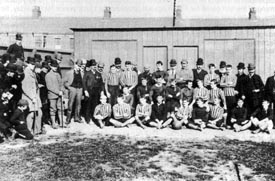 On 8 September Sunderland showed how far they had come in the last year by drawing 1 v 1 with Scottish cup runners up and Glasgow cup champions, Cambuslang. Remember the Lads had suffered an 11 goal drubbing the previous January. McKie was a notable absentee from the Sunderland line up, having previously played for the Scots team. The Wearside line-up for the season had basically started as follows: Kirtley, McDermid, Ford, Rennie, Dale, Gibson, Davison, Gloag, Dickson, Brady, A Peacock.
 A return fixture had been arranged with the Canadian touring team but cancelled at the last minute, Long Eaton Rangers, the holders of the Derbyshire Charity cup, agreed to travel to Newcastle Road. In truth it was a pretty one sided match and once more Breconridge, Brady and Peacock scored all the goals in a 5 v 1 triumph.
 Albion raced into a 2 goal lead, but Sunderland fought back to equalise. With minutes remaining Sunderland scored again. However, the goal was so hotly disputed (over the crossbar - remember no nets etc. in those days) that the Albion players left the field in a fit of pique. All hell broke loose and Albion’s transport was stoned in North Bridge Street. James Allen sustained a nasty eye injury that required surgery, quite ironic considering that the gate receipts were donated to the children’s hospital, EYE INFIRMARY, Infirmary and monkwearmouth dispensary!!
 Fortunately things calmed down a bit and the following week Sunderland travelled to Abercorn, where within 3 minutes they scored. It proved however to be a false dawn and the men from Wearside eventually succumbed 3 v 4.
 Grayston wasted no time in travelling over the water and found Tom Watson, in a public house, drowning his sorrows. Given the opportunity of assisting Sunderland he jumped at the chance and that evening, resplendid in a new suit, money in his pocket and cleaned up he was presented to the Sunderland Committee….a legend was born. He was given a house and a salary of 35 shillings per week.
