
Sunderland AFC 1887/88
___________________________________________________
On 25 August 1887 the Sunderland AFC half yearly meeting was held at the Workman’s Hall, Monkwearmouth. Again "crowded" Robert Thompson had been called away by business commitments and the Reverend McGarrigle held chair. After the minutes of the last meeting were read, the fixtures for the forthcoming season was announced.
It was evident that in order to improve Sunderland would have to dispense with local talent and rely heavily on imports from North of the Border. Some Wearside people were less than impressed with this change of policy. The season started in historic fashion...literally. Sunderland had started their lives playing in a strip of all blue, later changed to red and white halves, but for the very first game of the season the famous red and white stripes were introduced. They would never be discarded again. On 10 September the season got underway with Notts Mellors put to the sword 8 v 3. A week later old foes Darlington were entertained and defeated 3 v 1. St Augustine’s (1st game in red and white stripes), Shankhouse and Newcastle West End lost to the Wearsiders, and then it was time for the English Cup. Sunderland were now a cash rich club and after once more defeating Morpeth Harriers in the FA/English Cup, home and away, they recorded then record receipts of £70 for the visit and defeat of Newcastle West End. Elswick Rangers were thrashed 6 v 2, and before the next round of the "FA cup" a very interesting game against Blackburn Rovers was arranged at Newcastle Road. Having received a bye from the DCC due to winning the trophy Sunderland were without a fixture and entertained a strong team from Lancashire. The "celebrated" Blackburn rovers needed no introduction, having held the English Cup for the previous 3 seasons, and true to form they would defeat the Wearsiders 2 v 0. However it was no so much the result as the overall impression that was important. Sunderland were now showing that they were not far behind the very best. Bishop Auckland Church Institute were then defeated 5 v 2, but the Percy Ironworks claimed a surprise scalp of the Sunderland A team, by a narrow 1 goal victory. The next round of the English Cup saw Sunderland draw Middlesbrough, at Linthorpe Road, and a crowd of nearly 8,000 saw a thrilling match in which the Teesside team fought back to draw 2 v 2. In the replay on Wearside Sunderland triumphed 4 v 2 and would play Old Foresters at home in the next round. However later that night 2 Middlesbrough fans overheard a Sunderland man indicate that he had been paid 30 shillings for playing. Middlesbrough protested, an FA enquiry was held at Darlington and London, 3 men were suspended for 3 months for professionalism and Middlesbrough awarded the tie by default. The actual meeting didn’t take place until January and the charge preferred by Middlesbrough was that:
The commission in making their decision looked at the books of the club and found that each of the above players had been paid 30 shillings in train fare from Dumfries, and were therefore technically in breach of the Association challenge cup rules.
The following week Sunderland played Durham University in the second round of the Durham Challenge Cup, having received a bye from the initial stage. The attendance at Newcastle Road was smaller than expected due to a Football Association game in Newcastle, Shankhouse Black Watch against Aston Villa. The university kicked off, and soon found themselves in severe trouble. Fred Dale, who would later become caretaker manager played extremely well and contribute to Sunderland dishing out an 8 v 0 hiding. The Sunderland side was: Kirtley, Ford, Oliver, Richardson, Dale, Hastings, Stewart, Davison, Halliday, Gloag, and Monaghan A fixture with a team from Bolton had been arranged for 24 December, but subsequently cancelled Derby Junction were invited to fill the breach and accepted. The only problem was that on route to Sunderland the Junction team caught the wrong train at Leeds, and by the time they arrived on Wearside it was too late to finish the game in daylight. Agreeing to play the match on the Monday, 26 December, Sunderland annulled their arranged match with Owlerton Sheffield, and on a rain sodden pitch the Wearsiders attacked the Road End. Junction were a good test, having reached the 5th round of the English Cup and over 5,000 spectators turned out to see Sunderland win 4 v 0. The next holiday match was played on 2 January against Scottish side Cambuslang, and not since the visit of Port Glasgow 1 January 1885 had Sunderland received such a good thrashing. Cambuslang arranged to meet Sunderland as part of tour match and on their last game had defeated Newcastle West End 4 v 0. They were in good form, and a cracking side. The pitch was in dreadful condition and with the home side winning the toss (the only thing they would win that day) the game kicked off at 2.30pm. Plenderleith kicked off for Cambuslang defending the Road End and the most one sided game in ages developed as the Wearsiders capitulated 0 v 11. Truly a disaster. It was therefore with trepidation that Sunderland approached their final holiday game, against another Scottish side Partick Thistle. The supporters had stayed loyal and a good following gave Sunderland a rapturous reception, well as rapturous as you got in those days!! Anyway Sunderland had injury worries with both Monaghan and Davison unable to take part. James Allen and Jopling deputised and having lost the toss Halliday kicked off defending the Road End. At half time the score was even, but Thistle upped the tempo in the second half and after a Paul goal had given them the lead, 2 quick Partick goals saw Sunderland on the rack 0 v 3. Gloag and Halliday pulled the deficit back but the Scots ended up winning 2 v 4…not unexpected. 4 days later south Bank were thrashed 5 v 1 in a friendly before Sunderland ventured north of the border to play Ayr United. Whether the fixture had been set up by Ayrshire native James Allen is not known, but what was evident was that once more the Scots would provide a stiff test. The game was played at Beresford Park, Ayr and considerable interest had been aroused. The first half was fairly even, until just before half time "the home players managed to elude the Sunderland custodian"…in other words 1 v 0. Second half and on 55 minutes Ayr made it 2, 75 minutes and it was 3, just before the end it was 4. Research fails to identify the Sunderland scorer, although Halliday is a good bet. The Scots triumphed 4 v 1. The same day as the above, 14 January Sunderland A defeated Gateshead Swifts 5 v 2. There then followed some good victories: Whitburn 0 v 1 Sunderland (Durham challenge Cup) Before Sunderland played 2 canny games. The first of which was against Newcastle West end By now Sunderland and Newcastle were becoming great rivals, and for this fixture a train full of Newcastle fans arrived on Wearside. West End fielded their full strength "cup side" a noble gesture considering the match was once more for charity and the Monkwearmouth and Southwick dispensary. At 2.30 pm the teams kicked off, Sunderland winning the toss and decided to play from "the high end". The pitch was slippery underfoot and Sunderland raced into a half time lead through Davison. The game opened up I the second half, and although Gloag scored again for Sunderland, West end stormed back and triumphed 3 v 2. February 14 was a holiday; Shrove Tuesday and Sunderland arranged a match with Blackburn Olympic. As it was a holiday it gave Tradesmen and their Assistants an ideal opportunity to watch the match and a large attendance turned up for a game that would kick off at 2.30pm. The weather was poor and in fact hail had fallen heavily just prior to kick off. Olympic were regarded as a strong team, and included the Chadwick brothers from Blackburn Rovers. The game was very one sided in the first half and Olympic raced into a 3 goal lead. Whilst Sunderland did reduce the deficit it was an uphill struggle, made harder by the fact that Davison injured himself and was unable to play for most of the second 45. Down to 10 men the Wearsiders performed creditably to keep the game scoreless for the remaining minutes. 18 February saw the visit of Sheffield Park Grange and due to the terrible stormy weather there was a poor attendance. The Yorkshire club in truth played poorly and were no match for Sunderland who triumphed 6 v 0. It was described by the local press as a "hollow victory". Sunderland then travelled to Bishop Auckland to play the church Institute team, but found when they got there that the CI team had cried off. In haste and as recompense for what would have been a wasted journey the Town Secretary agreed to get together a Bishop Auckland Town X1. The game ended 1 v 0 to Sunderland, but it hadn’t been a very promising trip.
On the same day Sunderland A were in action against Backworth Hotspur in the Ashington Cup and whilst the score of 5 v 0 is interesting the line-up is worth noting as it begins to give you an idea of the Sunderland squad in those days: Liddle, Wishart, Douglas, Erskine, Cook, Anderson, T Douglas, H Lord, Curran, J Lord, Jopling By this time Sunderland had progressed to the semi final of the Durham Challenge Cup, the 7 v 1 triumph over Southwick giving the Wearsiders the chance to play old rivals Darlington. At the neutral Bishop Auckland venue over 5,000 witnessed the match, and a cracker it was too. The game commenced at 3.30pm in what was described as "weather of a pleasant description". Darlington won the toss and elected to defend the goal at the entrance end. It was a fast game, refereed impeccably by TD Dales of Medomsley, with the Sunderland backs having fine games. At half time there was no score, but into the second half and Stewart scored for Sunderland to really pile the pressure on Darlington. The opponents responded with an equaliser from Hutchinson. It would need a replay to sort the 2 sides out. The replay was staged on 24 March, again at bishop Auckland, and although the crowd wasn’t as big as for the previous game they were in good voice. In beautiful weather conditions referee Stacey from Sheffield started the game and Sunderland were soon in the ascendancy. Against the run of play Hutchinson scored for Darlington, but a few minutes after half time Gloag scored a beauty for Sunderland. Not long after the same man scored again. The Wearsiders hung on for victory and would meet Bishop Auckland church Institute in the final. By now the Easter holiday period was upon us and Sunderland as usual arranged fixtures against some high profile teams. Blackburn Olympic travelled to Wearside for the second time in the season, but this time it was Sunderland who triumphed 4 v 1. Sweet revenge for the defeat a month or so ago. 2 April and this time Sheffield were put to the sword in front of an incredible 10,000 people. The 4 v 0 scoreline was just reward for some inspired play. 3 April and St Bernard’s were put to the sword 5 v 1. This had been a great period for Sunderland and they were in terrific spirits for the 7 April DCC final, which would be played at Darlington’s Feethams Ground. It was a beautiful day and "the excursion train from Sunderland brought a large addition to the total attendance". At kick off time 3.30pm there were approximately 6,000 people in the crowd, and having won the toss Bishop Auckland took advantage of the wind which blew from the Pavilion End. Smith gave Bishop Auckland a first half lead, and by early in the second half it was looking ominous for Sunderland. However, just as all appeared lost Kilpatrick took advantage of a "scrimmage" following a corner and rifled the ball home. Sunderland had equalised, there was loud applause. The church Institutes frailties at set pieces was again evident as shortly afterwards, from a carbon copy move Davison gave Wearside the lead. Sunderland hung on for a famous 2 v 1 triumph. They had won the cup again. In summary it was noted that "Sunderland were a fairly balanced side, the honours though were undoubtedly due to Kirtley, whose vigilance was never surpassed. Ford and Oliver were a pair of equally good backs. The left backs were clearly inferior to the other side, while the forwards all played with good combination and were the mainspring of the team". The honours however didn’t end there for Sunderland. One week later Sunderland A team played Houghton le Skerne in the semi final of the Durham Medals Cup and triumphed 4 v 0. The same day Sunderlands first team entertained Birtley in a friendly match that ended 4 v 4. It was noted that the referee was Dr Somerville of Queens Park, who had moved from his native Scotland to take residence in the Town. The crowd for this match was lower than usual due to a competing Rugby "attraction". Remember prior to James Allen Sunderland had been a rugby town. How times would change!! The A teams of Sunderland and Southwick met at Ashbrooke on 21 April in the final of the Durham Medals Cup and the team from Newcastle Road quite simply obliterated Southwick 13 v 1. By now Sunderland were establishing a good reputation for football and it was no surprise when Renton agreed to play on Wearside. Renton, at that time, were the holders of the Scottish challenge Cup, and brought the trophy to England for this match. There was much interest when it was displayed. The game on 21 April went with form and the Scots won 4 v 2. Well that was basically Sunderlands last defeat of the season as the next 3 games were won as follows: Newcastle West End 0 v 2 Sunderland On 3 May 1888 the following appointments were made: Mr Robert Thompson President The above men continued the good work of James Allen, taking out an insurance policy, to guard against injuries, and also paying into an accident fund. A cabin for reporters was build at the football ground.
Sunderland faced a potentially serious problem, brought about by the man who had founded Sunderland AFC. Now voted off the Sunderland AFC Committee Allen was disenchanted with things and he called a meeting at the Empress hotel in Union Street to form Sunderland Albion.The club was initially made up of dissatisfied Sunderland AFC members and a lot of the Scotsman who played for the club. Sunderland Albion would play their matches at the Blue house Field, Hendon, formerly used by Sunderland AFC with club HQ being the Waverley Hotel in Norman Street. Grayston, a stalwart of Sunderland AFC was offered terms by Allen, but refused. The 2 men fell out and didn’t speak to each other for nearly 3 years. The principal backers of the Albion team were the Glassworks, more specifically James Hartley, of the Wear Company in Millfield. Allen, living in Whitehall Terrace was a neighbour of Hartley’s. Seven of Sunderland AFC's "Scotch" players joined Albion as did Alderman Potts, Sunderland's first president. By the end of the season the Albion club had prospered to such an extent that they defeated Newcastle West End, many years their senior as a team. The value of Scottish footballers was clear for all to see. Picture of SAFC team above courtesy of Rob Mason |
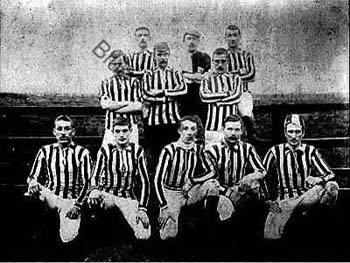 Once more Sunderland used the season to spend big money bringing Scots teams down to Wearside. Renton were paid £40, and Sunderland paid 7 Scotsmen, 4 from Dumfries to play. Income and expenditure for the campaign would amount to almost £1,000.
 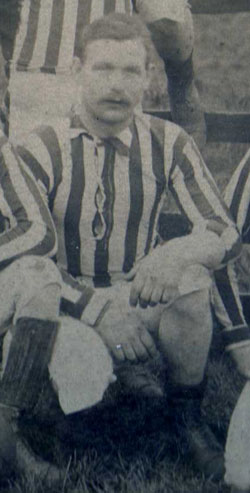 On 10 December a benefit game for the Monkwearmouth and Southwick Dispensary was played with Morpeth Harriers the opposition. Sunderland were under strength for the game with Monaghan (pictured right) and Hastings, amongst others involved in a County match on Teesside. Instead the Reverend Kinloch deputised for a forward position and in front of another large attendance Sunderland forced a 2 v 2 draw.
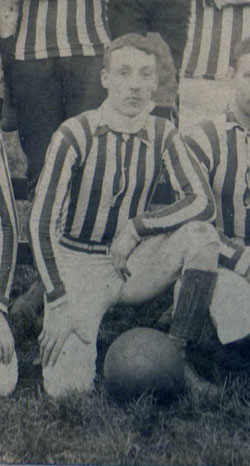 3 March and a trip to North Lodge Darlington, where St Augustine played Sunderland in a friendly game. The Wearsiders won the toss and kicked off with the wind and the "hill" in their favour. The game ended up 6 v 3 to Sunderland with James Allen playing particularly well. The line-up as follows: Smith, Ford, Oliver, Spain, Halliday, Moore, Davison, Stewart, Allen, Gloag (pictured left), Kilpatrick.
 The appointment of Tyzack was important because in doing so he ousted James Allan, Sunderland AFC's founder, from office. Whilst reports may give other reasons as to the formation of Sunderland Albion, it is likely that Allan was less than impressed by his public demise, and may have been prompted to take on "his club", in a power struggle.
